
Omit Needless Words
add needless subtitles

Speaking ESL is some of the best training I do as a writer. My girlfriend is Russian, English her second of five languages. I don’t use idioms or cliches when we share what’s alive in us. My cultural references need explaining, and we’ll waste energy on understanding the tools of communicating instead of building shared understanding. I omit needless words and ideas. Our language is stripped, yet dense, as we discuss the metamodernism, gender antagonism, epiphenomenology that excites us.
I saw on Twitter someone lamenting the downfall of writing, as always. Those aging out of relevance find refuge in Declinism. The world is getting worse—for them, and thus for everyone.
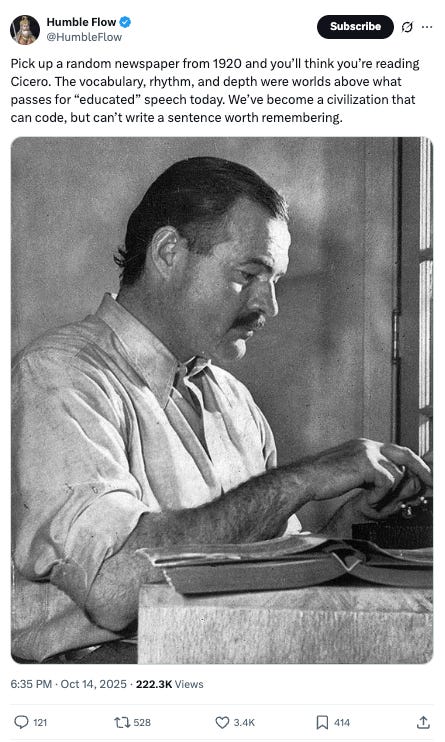
I did my degree in English literature: Romantic and Victorian eras, Modernist writing, up to Postmodernism where I quickly jumped ship, too attached to the yearning sincerity of Keats to stomach ironic bitterness. I know how writing changed from the 1820s to the 1920s, and now to the 2020s. This tweet could have been written 100 years ago with the same audience and effect. It’ll be rewritten in 2120.
Language becomes more efficient. Older writers were incentivized to publish longer texts. Pushkin was paid the equivalent of five cows per line of Eugene Onegin.

I read and write about reading and writing. Strunk and White, Solstein, Zinnser—all advocate for linguistic efficiency. Omit Needless Words is as dense a rule as possible, and a universal compass for line editing. We are constantly trimming the fat. The rubenesque plump sentences of Dickens are now brutally lean, ripped, shredded sentences of X and LinkedIn listicles, the latter often paint-by-numbers formulas and Typeshare templates. We’re considerate of dwindling attention spans while parents monger Satanic panic over TikTok and AI slop.
The phones haven’t ruined our attention. Content has always been optimizing. Evolution does things on the cheap. Caloric scarcity led to energy optimization. We’re still optimizing and always will be, in the formation of our bodies and the information of our content.
Why use 1000 words for an idea when 100 will do?